
Straight talk
on distance learning.
The distance learning market is full of advertising and hard to see through. Here you get the guidance that really counts before you enrol: which paths exist, which one fits you and how to spot reputable providers.
Frequently asked questions
What is the difference between a distance degree and a distance course?
A distance degree leads to an academic degree such as a bachelor or master through a state-recognised university. A distance course only ends with an academy certificate.
Can I study at a distance without a school-leaving diploma (Abitur or Matura)?
Often yes: with work experience and completed vocational training a degree is frequently possible, sometimes via an aptitude test. The rules differ by country.
How do I recognise a reputable provider?
By three things: a state-recognised university, an accredited programme and a clean contract. Seals and discounts alone say little.
What does distance learning really cost?
Usually more than the advertised monthly rate. Exam and extension costs are often added, partly offset by funding schemes.
The big questions before you enrol
Six topics, each explained in depth on its own page, plus two follow-up pages per topic. Start wherever your question is.
Distance degree, distance course or online course?
These three terms are often advertised alike, but lead to very different qualifications. The comparison shows what counts in the end.
| Feature | Distance degree | Distance course | Online course |
|---|---|---|---|
| Qualification | Academic degree (bachelor, master) | Academy certificate | Certificate of attendance |
| Provider | State-recognised university | Academy or education provider | Anyone |
| Recognition | State-recognised, measured in ECTS | Often ZFU-approved, usually without ECTS | No formal recognition |
| Typical duration | 3 to 8 semesters | Weeks to months | Hours to weeks |
| Suited for | Formal qualification, career step | Professional development | Trying out, refreshing |
A guide, not a ranking. The terms are not always cleanly separated. When in doubt, what counts is which qualification ends up on the certificate and who awards it.
The qualifications map
From certificate to doctorate, measured by size in ECTS rather than by name. This is how you place every qualification correctly.
Certificate
up to 30 ECTSBachelor
180 to 240 ECTSMaster
60 to 120 ECTSDoctorate
Research, no ECTSECTS stands for European Credit Transfer System and measures workload: one point equals around 25 to 30 hours. The name of a qualification says less than its size and the body that recognises it.
Your distance learning knowledge, lesson by lesson
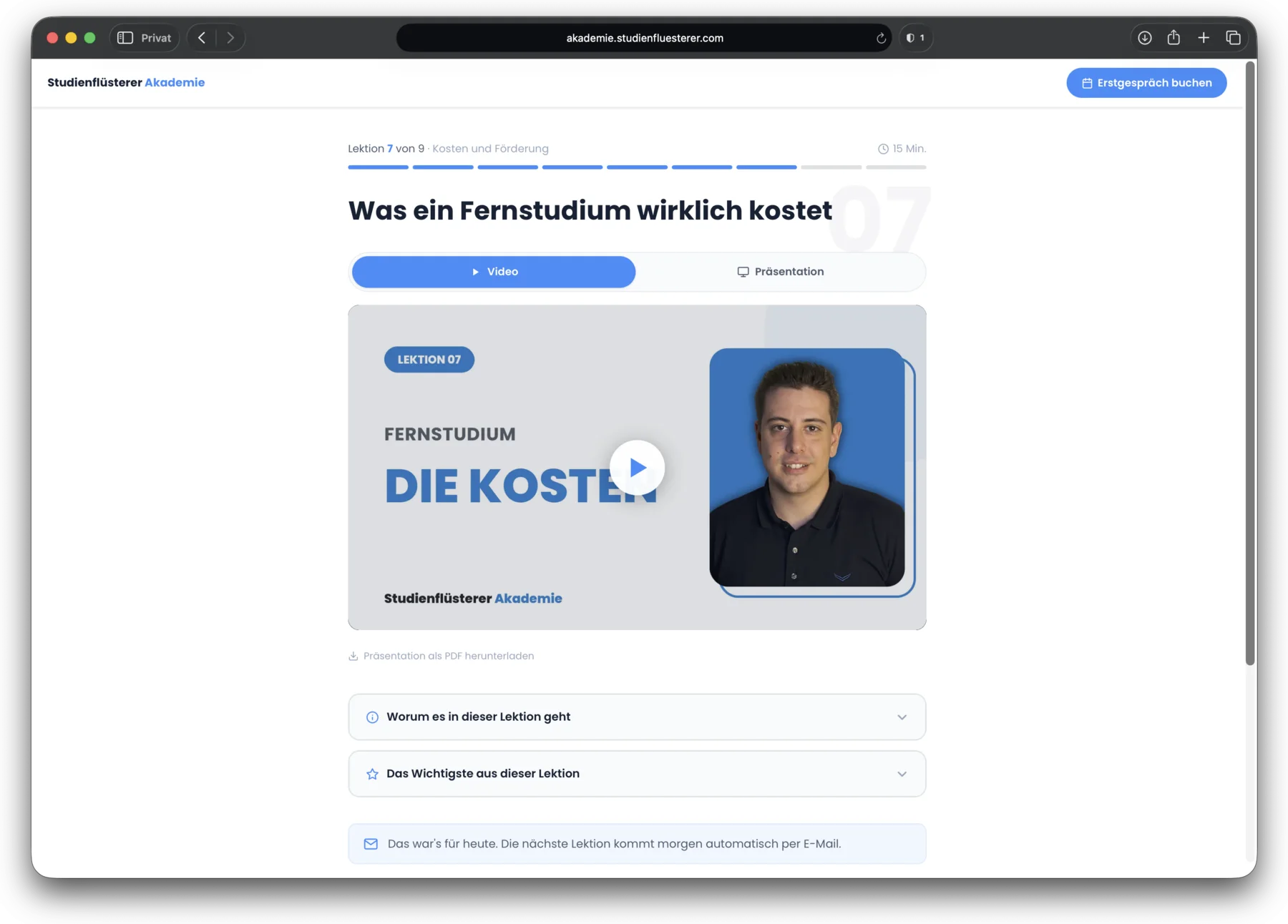
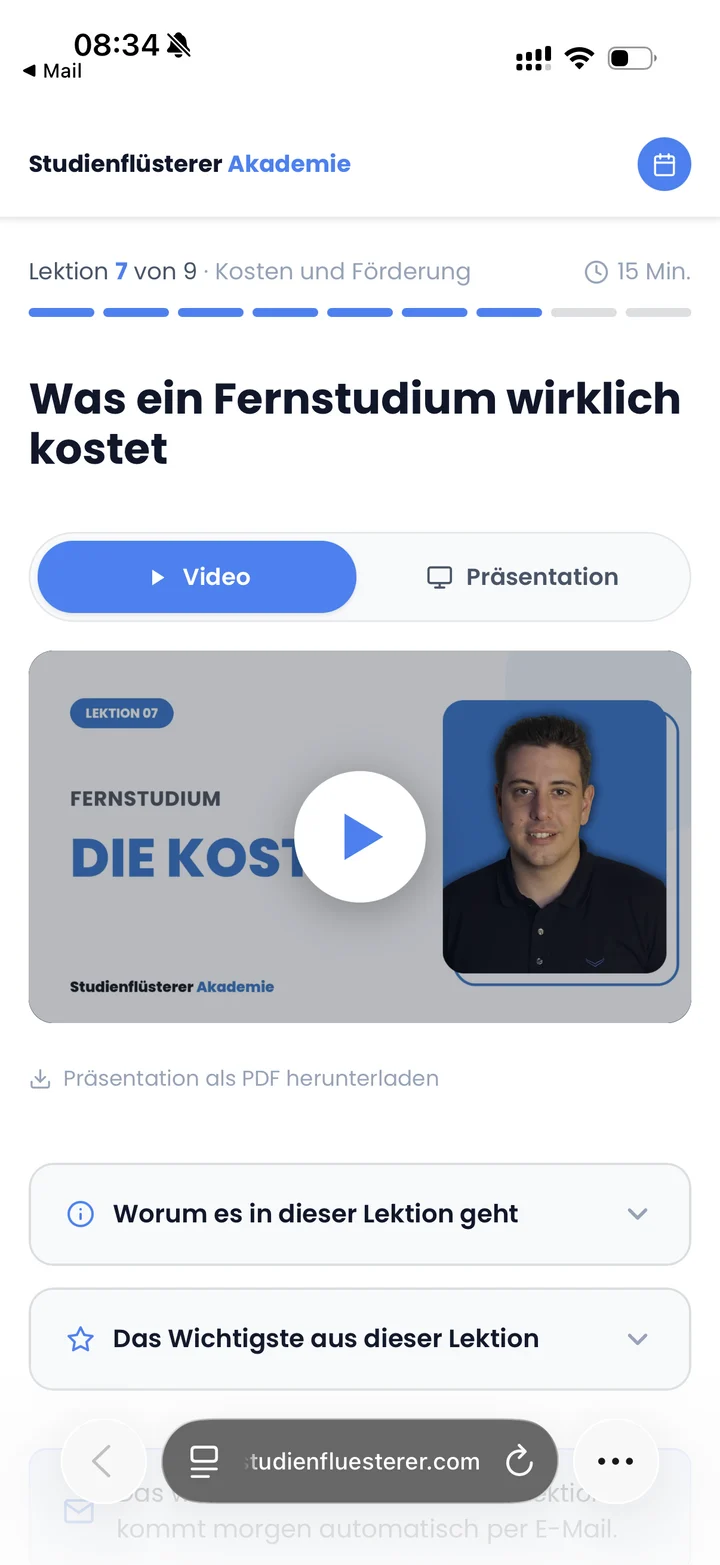
In the Studienflüsterer Akademie you get the most important basics on distance learning, costs, funding and credit transfer as a compact video course. A new lesson every day, free and at your own pace.
- Short video lessons with a presentation to take away
- A new lesson in your inbox automatically every day
- On laptop and phone, learn whenever and wherever it suits you
Recognition in Germany, Austria and Switzerland
Who decides on recognition, and what matters in each country?
Germany
In Germany, the ZAB (Zentralstelle für ausländisches Bildungswesen, the central office for foreign education) uses the anabin database to assess how a degree should be classified. Degrees from accredited German universities are recognised nationwide. For distance courses, ZFU approval ensures consumer protection, but it does not replace academic recognition.
Austria
In Austria, the BMBWF (Bundesministerium für Bildung, Wissenschaft und Forschung, the federal ministry of education, science and research) is responsible, and NARIC Austria handles foreign degrees. Bologna-compliant degrees from the EU are usually recognised without an individual procedure. For regulated professions, an additional check may be required.
Switzerland
In Switzerland, the SBFI (Staatssekretariat für Bildung, Forschung und Innovation, the state secretariat for education, research and innovation) is the point of contact. For non-regulated professions, a Bologna degree is often enough without a formal procedure. Regulated professions such as nursing or teaching need recognition, and the procedure typically takes a few weeks to months.
The information on this page is general in nature and is meant as orientation. It does not replace an official credit transfer or recognition decision by the relevant university and is not legal advice. The universities and the responsible bodies decide: the ZAB in Germany, the BMBWF in Austria and the SBFI in Switzerland. Always check your specific case directly with the university before you enrol.
How to spot reputable providers
Six criteria that a good offer meets. Going through them saves you weeks of your own research and expensive wrong decisions.
Recognition and accreditation
A state-recognised or accredited university is a must. Accreditation runs through the Akkreditierungsrat (accreditation council) in Germany, AQ Austria in Austria and the AAQ in Switzerland. Without this stamp, the degree is worth little to employers and authorities later on. Check this first, before content and format.
Programme structure and module plan
An accessible module plan shows what a programme really contains. Watch the ratio of compulsory to elective: a lot of compulsory is predictable, a lot of choice allows specialisation. Vague descriptions without concrete modules are a warning sign.
Costs and hidden fees
The advertised monthly rate is rarely everything. On top of it there are often exam, extension and retake fees as well as costs for on-site phases. Calculate the total over the whole term, not the rate.
Contract and cancellation
Term, extension, notice periods and the right of withdrawal must be clearly set out. A clean contract states the total costs and all conditions without traps in the fine print.
Credit for prior learning
Check whether earlier academic work or work experience can be credited. This can save time and money. Anyone who credits everything or nothing across the board, without seeing your documents, is not credible.
Support and availability
Response time of the support team, exam dates per year, rules for illness or interruption. This sounds like a detail, but it decides whether you finish within the standard time or drop out frustrated.
If an offer stays clean on all six points, it is usually reputable. If it already stumbles on recognition or the contract, caution beats a discount.
The terms you will come across
The jargon around distance learning, untangled once and for all. So no brochure can lose you with abbreviations again.
The decision roadmap
From the first idea to enrolment, in the right order.
Clarify your goal
Does your goal actually require a degree, or is further training enough? This honest question at the start can save years and several thousand euros in the best case.
Choose format and qualification
Distance degree, distance course or online course, and which qualification fits? The size in ECTS counts more than the name on the brochure.
Check admission
With Abitur or Matura, or without? Check the admission routes, including aptitude test, trial semester and credit for prior learning.
Compare providers
Put recognition, accreditation, module plan, costs and contract of three to five programmes side by side. Leave the advertising out of it.
Sort out financing
What does it really cost, and which funding schemes fit you? Calculate the total costs over the whole term, not the monthly rate.
Enrol and stay on track
Check the contract, sign, and set up a realistic weekly plan. Because most people fail not because of the material but because of the calendar.
Frequently asked questions about distance learning
The most important questions about recognition, degrees, costs and process, answered concisely.
Is a distance learning degree recognised the same as an on-campus one?
Yes. What matters is not the mode of study but whether the university is state-recognised and the programme is accredited. A bachelor or master from a recognised distance university is legally equivalent to an on-campus degree. The label distance learning usually does not appear on the certificate.
What does ECTS mean?
ECTS stands for European Credit Transfer System. It measures the workload of a programme, not just lecture time. One ECTS point equals around 25 to 30 hours. A bachelor usually comprises 180 to 240 points. This makes study programmes comparable across borders.
What is accreditation and why does it matter?
Accreditation is the quality review of a study programme or university by an independent body: the Akkreditierungsrat (accreditation council) in Germany, AQ Austria in Austria, the AAQ in Switzerland. Without accreditation, a degree is often worth little to employers and authorities. It is the most important signal of credibility.
What does ZFU approval mean?
The ZFU is Germanys central office for distance education (Zentralstelle für Fernunterricht). It reviews distance courses for consumer protection, such as the contract and learning goals. ZFU approval is mandatory for distance courses in Germany. It is not, however, an academic recognition and does not turn a course into a degree programme.
How long does distance learning take?
That depends on the degree and your pace. A part-time bachelor typically takes 6 to 8 semesters, a master 3 to 4. Many universities allow free extensions. Credited prior learning can noticeably shorten the time.
What is the difference between bachelor, master and doctorate?
The bachelor is the first academic degree and the prerequisite for the master. The master deepens a subject and qualifies you for specialist and leadership roles. The doctorate (Promotion) is independent research and leads to a doctoral title. Each level builds on the one before.
What are CAS, DAS and MAS in Switzerland?
These are Swiss continuing-education formats at university level. CAS is the smallest with around 10 ECTS, DAS comprises about 30, MAS around 60 and concludes with a Master of Advanced Studies. They are aimed at working professionals and can often be built on top of each other.
Can I get work experience or prior learning credited?
Often yes. Many universities credit earlier academic work, further training or relevant work experience. This can shorten a programme by months and save costs. How much is possible is decided by the university case by case. A blanket all or nothing is a bad sign.
What funding options are there?
Depending on the country and your situation, there are various funds: in Germany, for example, Aufstiegs-BAföG (upgrading grant), a Bildungsgutschein (training voucher) or scholarships; in Austria, Bildungskarenz (education leave) and regional funding; in Switzerland, federal contributions for higher vocational education. It is worth looking at funding before you enrol.
How much time do I need to plan per week?
As a rule of thumb, a part-time programme takes around 15 to 20 hours per week, more during exam phases. What matters is regularity rather than the total number. Most people fail not because of the material but because of planning alongside work and daily life.
What happens if I fail an exam or need to pause?
Reputable universities allow retakes and offer rules for illness or a break. Before enrolling, check how many attempts you have, whether leave semesters are possible and whether extra costs arise. This is exactly where you see how fair a provider is.
How do I find out whether distance learning suits me?
First clarify three things: does your goal actually require a degree, does the format fit your daily life, and is the provider reputable? If you are still unsure afterwards, a conversation with an independent adviser helps before you sign a contract.
More Klartext?
This page gives you the basics. For the next step, there are several ways to go deeper.
Studienflüsterer
Personal guidance on your own situation. The Studienflüsterer, the consulting project behind this page, looks at your case in a free initial consultation.
Free initial consultationThe book
Fernstudium Klartext will soon be available as a book too: the full orientation in depth, to read at your leisure and look things up.
More soonThe academy
The most important basics as a free video course. A new lesson every day, at your own pace.
To the academyFernStudent
The distance-learning facts in numbers: how many study by distance learning, what it costs and how much time it takes, sourced and free of charge.
To the data hubUnsure which path fits you?
The quickest way to clarity is a conversation. In the free initial consultation, the Studienflüsterer looks at your situation personally, honestly and with no obligation.